
These works are for sale
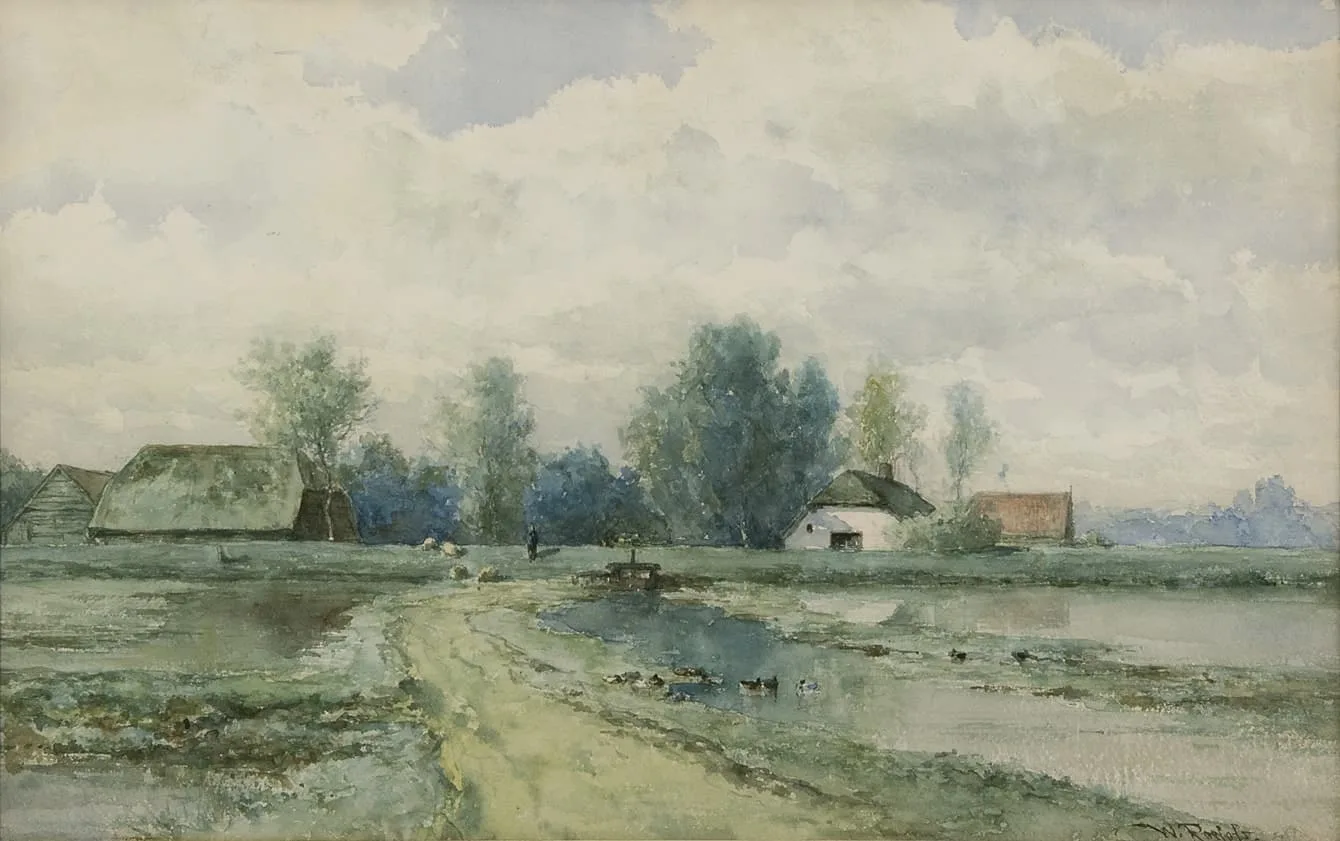
Willem Roelofs, a painter in development
Willem Roelofs was born in Amsterdam in 1822 and spent his youth in Utrecht. In 1839, Willem Roelofs moved to The Hague to take lessons at the studio of the landscape painter Hendricus van de Sande Bakhuyzen. He subsequently undertook a study trip along the Rhine to Germany and also stayed in Oosterbeek several times, before settling in The Hague. In 1847, he was one of the co-founders of the Hague artists' association Pulchri Studio.
Shortly thereafter, Willem Roelofs moved to Brussels and developed from a romantic landscape painter, through realism, into an impressionist painter. Willem Roelofs was an active participant in the Brussels Salon exhibitions and soon achieved success. In 1848, the King of Belgium purchased a Drenthe landscape, and a Gelderland landscape was awarded a gold medal. His name was established, and various awards and honorary memberships would follow throughout his career. In 1855, Roelofs was a co-founder of the Societé des Aquarellistes in the Belgian capital.
Willem Roelofs and the Hague School
In 1852, Willem Roelofs was one of the first Dutch artists to stay in Barbizon. Following the example of modern French landscape painters, he began working there even more directly from nature than he had previously done in Oosterbeek. From 1856 onwards, he also applied the French motto ‘let us return to nature’ to his depictions of the Dutch polder and meadow landscape. A number of important Hague painters would follow him in his atmospheric art. This made Willem Roelofs one of the pioneers of the Hague School.
Willem Roelofs always maintained contact with the Netherlands and faithfully submitted work for exhibitions. Moreover, from around 1860 onwards, he made a study trip to our country almost every year during the summer months. He painted frequently ‘en plein air’ in the watery landscapes near Kortenhoef, Noorden, and nearby areas such as Reeuwijk, Zegwaard, and Gouda.
Willem Roelofs often painted the drawings and oil sketches he made on prepared canvases, which he attached to the lid of his paint box with thumbtacks. His drawings and sketches formed the basis for the paintings and watercolors created in his studio in Brussels.
In 1887, Roelofs settled in The Hague with his family and remained fascinated by the Dutch polder landscape until the end of his life. During a trip to Switzerland in 1897, he did not wish to paint the Swiss landscape. He found the vast Dutch landscape with its imposing cloudscapes more suitable for his style of painting. After suffering two strokes, painting became impossible. Roelofs died in 1897 at his brother-in-law's house in Berchem. Paintings by his hand can be found in foreign museums and in all major Dutch museums, including the Gemeentemuseum Den Haag and the Rijksmuseum.