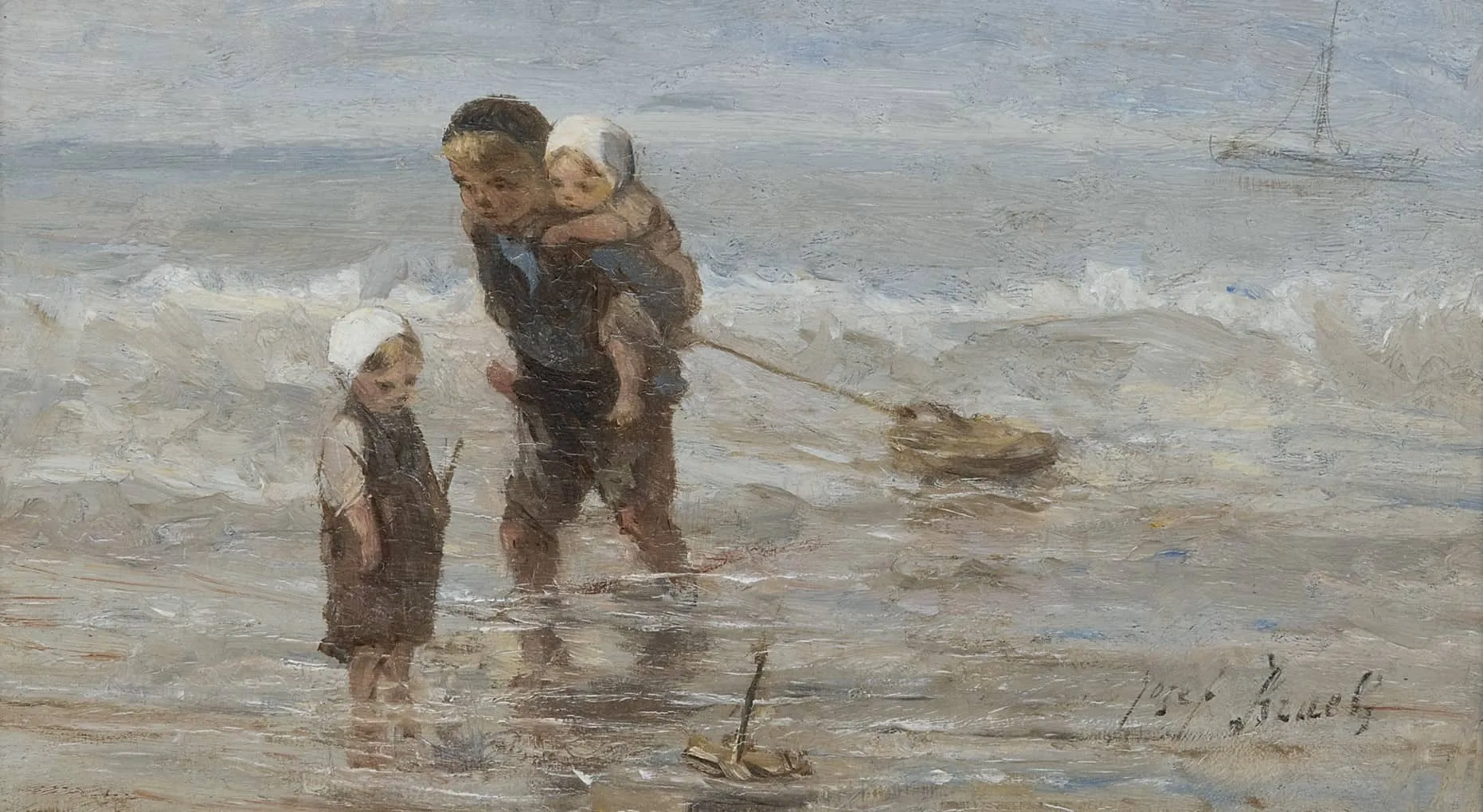
At this time we have no work by Jozef Israëls in our collection.
Jozef Israëls, an important painter of the Hague School
Jozef Israëls (1824–1911) is one of the most important artists of the Hague School. He was born in Groningen into a humble Jewish family. His parents initially envisioned a career as a rabbi for him, but at a young age, it became clear that his talents lay in art. From the age of eleven, he took drawing and painting lessons at the Minerva Academy in his hometown. At eighteen, he went to Amsterdam, where he learned the art of painting from prominent masters such as Jan Adam Kruseman and Jan Willem Pieneman.
From 1845 to 1847, Jozef Israëls lived in Paris, where he further honed his skills at the renowned École des Beaux-Arts and was strongly influenced by historical Romanticism. In the French capital, he met, among others, Johan Barthold Jongkind and painters of the Barbizon. Israëls was a man with a love of travel; he made several long journeys through Germany, Italy, and Spain. He incorporates the impressions from these travels into various paintings. Later, he also takes his son, Isaac, born in 1865, along on his travels. He recognizes great painting talent in him.
Jozef Israëls is a late bloomer; he does not make his debut until 1857 at the Paris Salon, about ten years after his return from that city. Back in the Netherlands, he shifts his focus to the life of the Katwijk fishermen. The fishing genre is enormously popular at the time, particularly in Germany and England. Israëls manages to depict the harsh life at sea poetically. He is a master at turning even misery into a moving composition. He achieves success after success with this, but his real major breakthrough comes in 1871, the year he moves to The Hague with his family.
Hague School
That move to The Hague proved significant for Israëls. There, he becomes close friends with Hendrik Willem Mesdag. Together, they are among the most important representatives of the Hague School. The painters of the Hague School—including Jacob and Willem Maris, Willem Roelofs, Anton Mauve, and Constant Gabriël—were inspired by their French counterparts, the Barbizon painters. The artists let themselves be guided by their feelings and reflect their emotions in typical Dutch scenes. The Hague School is an art movement where the interplay of light and sky takes center stage. It is full of Dutch elements, such as landscapes with Dutch skies featuring impressive cloud formations. But beach scenes, playing children, fishing boats on the beach, and windmills are also popular subjects. Jozef Israëls is particularly known for his restrained yet atmospheric depictions of the North Sea coast. Grayish pastel tones and a thick, impasto brushstroke are characteristic of Israëls. The skillful use of light-dark effects also gives his paintings a special appeal. For him, it is more about the atmosphere than the subject matter.
Teacher
During the time he lived and worked in The Hague, Jozef Israëls was the teacher of a large number of painters, including his own son Isaac and Bernard Blommers. The young Vincent van Gogh was a great admirer of Israëls. Jozef Israëls died in The Hague on August 11, 1911. Works by Israëls are held in numerous museum collections both at home and abroad.