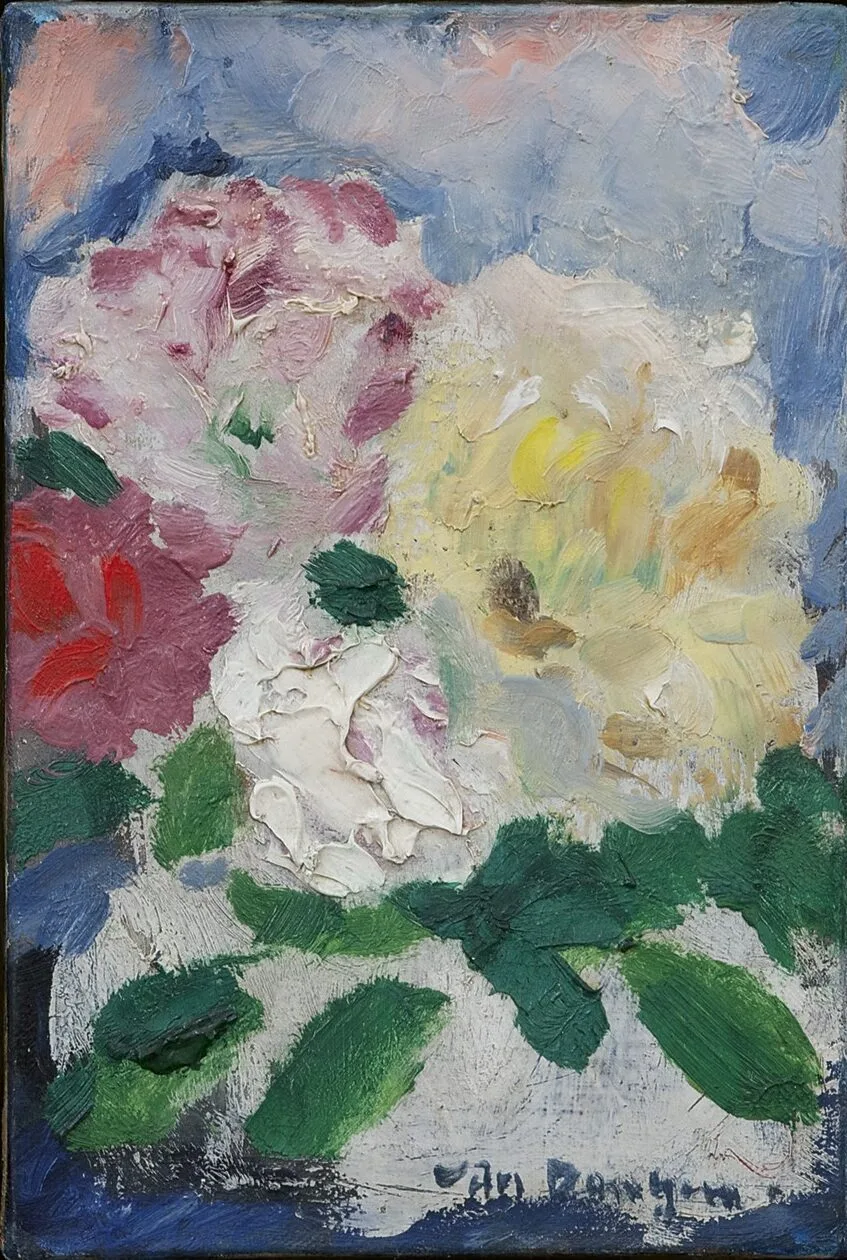
At this time we have no work by Kees van Dongen in our collection.
Kees van Dongen, painter of colorful portraits of women
Kees van Dongen (1877-1968) is perhaps the most French artist in the Netherlands. He was born in Delftshaven into a family that was not well-off. His talent for drawing was quickly recognized, but there was no money for an education, let alone an art school. The fourteen-year-old Kees was sent out to work. He was barely nineteen when he left for Rotterdam alone. Kees van Dongen made quick sketches of the red-light districts to earn some money.
At the end of the nineteenth century, he went to Paris for the first time. The bustling City of Light held an immense attraction for him. In 1900, Kees van Dongen settled permanently in Paris. He was soon absorbed into the cultural life of the avant-garde. Famous artists such as Picasso and Juan Gris were among his circle of friends. He even shared a studio with Picasso for a time. To support himself, he mainly created illustrations for magazines. When he picks up his brushes again, he makes a name for himself with the colorful portrait of women, which will remain his trademark for the rest of his life.
Kees van Dongen and Fauvism
Van Dongen is considered one of the founders of Fauvism. A key moment in his career is his participation in 1905 in the Salon d’Automne at the Grand Palais, where artists such as Matisse and André Derain also show their latest work. A critic visiting the exhibition speaks of ‘Les Fauves’ (wild beasts), and voilà, the nickname for a new art movement is born. Kees van Dongen exhibits various portraits of women there. He uses unmixed, bright colors and moves away from realistic representation: skin can just as easily be green, or purple. Also characteristic of Van Dongen are the super-large, black-rimmed eyes of women he paints and the omission of perspective. Connoisseurs praise his psychological insight, which gives the portraits a deeper layer.
After the First World War, his work becomes more realistic, and also somewhat more restrained. Kees van Dongen's name truly takes center stage when he begins to focus on portraying the French beau monde. The women he paints are elegant, refined, and captured in intense colors. Van Dongen is also a welcome guest at the illustrious parties of Parisian high society. Women will remain his most important muse throughout his life; one of the most famous women to pose for him is Brigitte Bardot. In 1929, he is naturalized as a Frenchman. He continues to paint into old age and dies at the age of 91 in Monte Carlo.