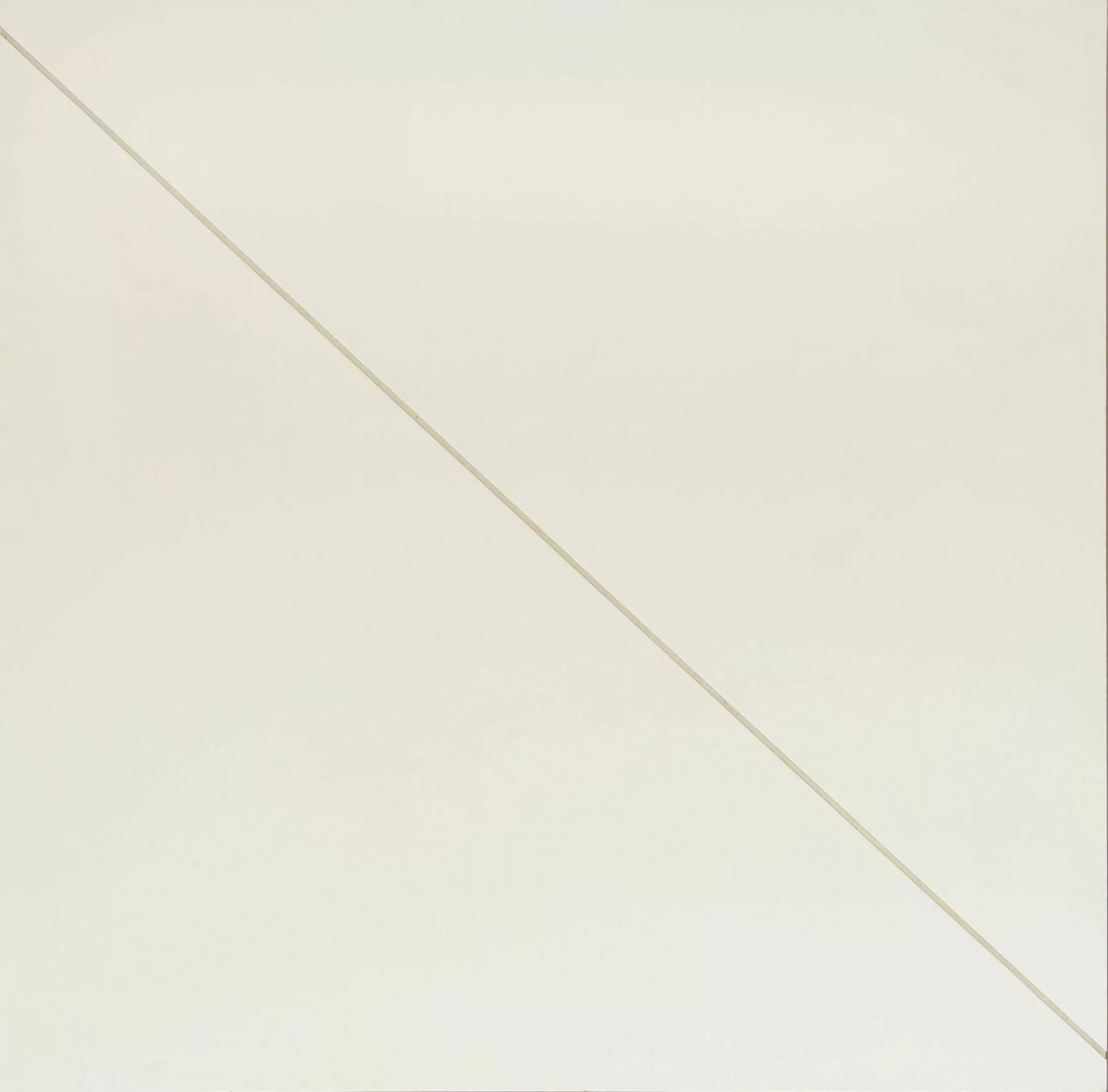
At this time we have no work by Ad Dekkers in our collection.
Ad Dekkers
As a sculptor, Ad Dekkers (1938-1974) is an important exponent of abstract-geometric art. He was trained at the predecessor of the current Willem de Kooning Academy in Rotterdam, in the publicity department. But after graduating he did not want to go into advertising, he chose to become an artist.
Exponent of geometric abstraction
Ad Dekkers is best known for his reliefs and monumental sculptures with simple geometric shapes that he made in the 1960s. The circle and the square were the two most important shapes for him. He saw these as contradictions that he wanted to bring together in the most harmonious way possible. He found inspiration from De Stijl artists – Ad Dekkers was especially a great admirer of Piet Mondriaan – and from artists from the German Bauhaus, the influential art and design school that existed from 1919 to 1933 and in which craft, art and technology were linked.
Minimal resources, maximum effect
Ad Dekkers tried to create the maximum possible effect with minimal resources, and he explored the concept of authenticity through abstraction. He usually painted his reliefs monochrome, in shades of white. Light plays an important role in Ad Dekkers' work. He was concerned with the effect the light had on his work. An important reason to admire his work in real life. It differs whether you stand directly in front of it or, for example, slightly to the side: the way the light falls on his work determines the atmosphere and appearance of his reliefs.
International recognition
The late 1960s were the heyday for Ad Dekkers. Jean Leerling, the then director of the Van Abbemuseum in Eindhoven, was a great advocate of his work. Partly due to his efforts, Dekkers participated in the São Paulo Biennale in 1967 – together with Peter Struycken, among others, with whom he was friends. And a year later, Dekkers took part in the prestigious Documenta in Kassel, together in a room with the American artist Ellsworth Kelly. Many Dutch museums have work by Ad Dekkers in their collection. For example, there is a meter-long relief at the entrance of Museum Kröller-Müller in Otterlo and the Rijksmuseum in Amsterdam has several of his works in their collection. His work has also been included in museums abroad, including the Museum of Modern Art in New York and Tate Modern in London. Ad Dekkers has also created various works for public spaces. His largest work Broken Circle is a twelve-meter concrete sculpture and is located in Amsterdam. Life was not easy for Dekkers. He was manic depressive and decided in 1974 - when he was only 36 years old - to end his life.