These works are for sale
Karel Appel, an important Cobra painter
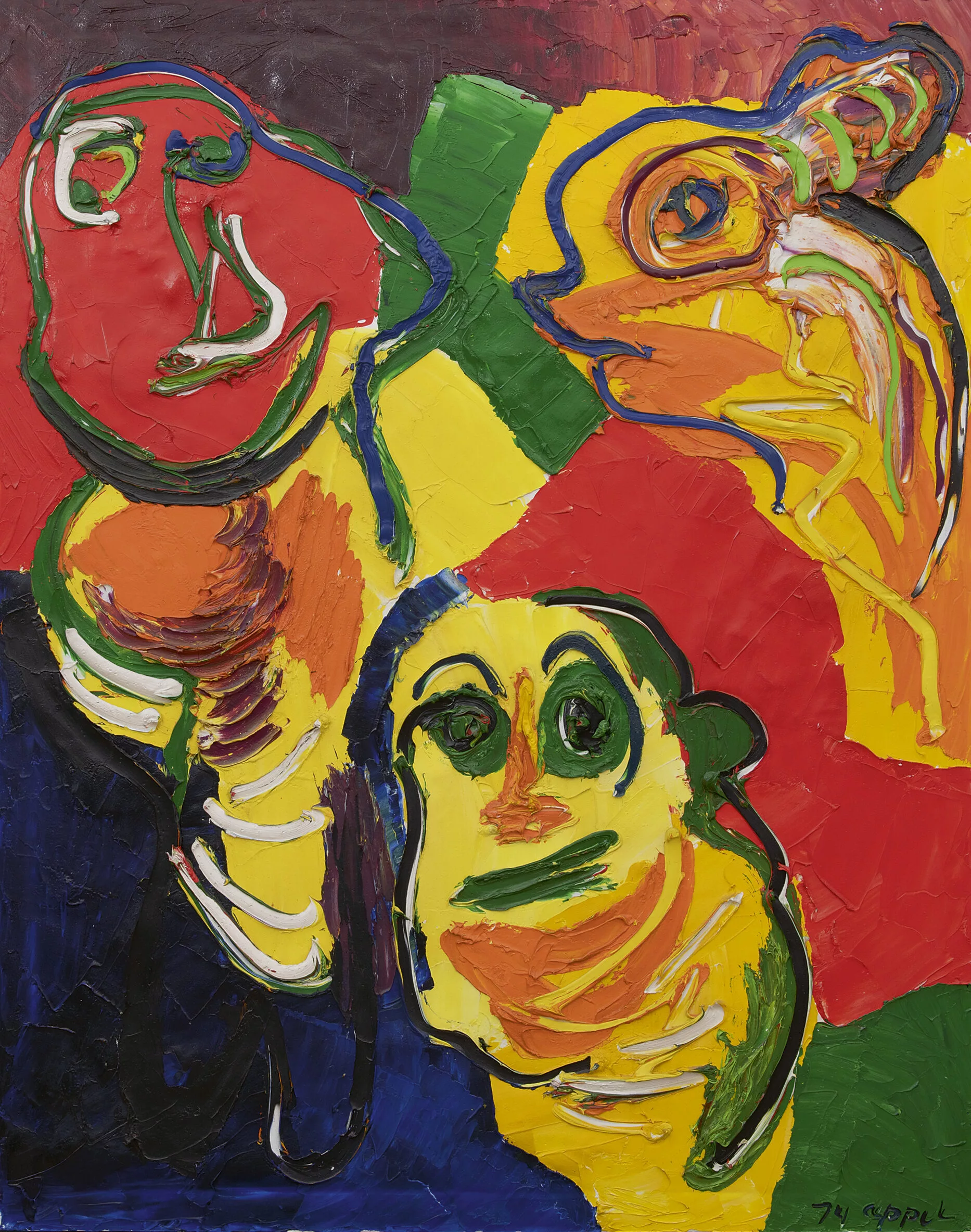
Karel Appel (1921–2006) is one of the most influential Dutch painters of the second half of the twentieth century. During the war years—between 1940 and 1943—Appel studied at the Rijksacademie in Amsterdam, together with Constant and Corneille, among others. In 1948, Karel Appel was closely involved in the founding of Cobra, named after the three cities from which the artists, poets, and writers originated: Copenhagen, Brussels, and Amsterdam. The Danish artist Asger Jorn and the Dutch artists Corneille and Constant were co-founders of Cobra.
Although Cobra existed as a movement for only a short time—the group disbanded in 1951 with a farewell exhibition in Liège—Cobra's influence on other European artists resonated for a long time. Appel is one of the most successful Cobra artists, and thanks in part to his immense vitality, he is the face of Cobra. His uninhibited art caused a shock in the then still conservative Netherlands. With an open mind, Karel Appel observes and admires primitive art, outsider art, and children's drawings. He is moved by the uninhibitedness of children. And although his expressionist work appears abstract, figurative elements are often present, frequently depicting women, birds, or animals.
Wild painter beast
‘I just mess around.’ It is perhaps the most famous statement in the history of modern Dutch art. Karel Appel said it in an interview following the controversial documentary that Jan Vrijman made about him in 1961. The Amsterdam barber's son Appel is portrayed in it as a wild painter beast, an image that stuck with him for the rest of his life.
Karel Appel paints expressively and impetuously, but that does not mean—despite his illustrious statement—that he is just doing whatever comes to mind. On the contrary, his paintings are well-thought-out compositions with clear lines and exuberant colors. He certainly applies every brushstroke carefully to the canvas. He knew very well what he was doing. Karel Appel is an extremely prolific artist. Besides being a painter, Karel Appel is also a sculptor and poet. He creates his sculptures from ceramics, but also from wood and aluminum. Throughout his life, he does not shy away from experimentation.
International Breakthrough
In 1953, Karel Appel achieved an international breakthrough following his participation in the São Paulo Biennial. By then, his name was established worldwide; he received solo exhibitions in Paris and New York, among others. Buyers lined up for his paintings.
Yet it took quite a long time before he was appreciated in his own country. It was not until 1968 that he received his first solo exhibition at the Stedelijk Museum in Amsterdam. But by then, Appel had long since ceased living in what he considered the ‘narrow-minded’ Netherlands. He felt more at home in Paris during the 1950s. Later, he had studios in Monaco, New York, and the Tuscan countryside, among other places. Karel Appel died in Zurich, Switzerland, in 2006. He is buried in the famous Père-Lachaise Cemetery in Paris. His paintings have found their way into renowned collections worldwide. For example, the Guggenheim Museum in New York and the Museum of Fine Arts in Boston have works by Appel in their collections. In the Netherlands, the Stedelijk Museum in Amsterdam has several Appels in its collection.